

The UK government has announced plans to establish eight Robotics Adoption Hubs across the country, backed by £40 million in funding, to help businesses and public services introduce advanced robotics and automation technologies. The initiative aims to improve productivity, address workforce shortages and strengthen Britain’s competitiveness in industries ranging from agriculture and manufacturing to healthcare.
The new centres will provide specialist advice, technical expertise and practical support to organisations seeking to integrate robotic systems into their operations.
Robotics Investment to Support UK Industry and Public Services
The programme forms part of the government’s efforts to encourage technological innovation and modernise key sectors of the British economy.
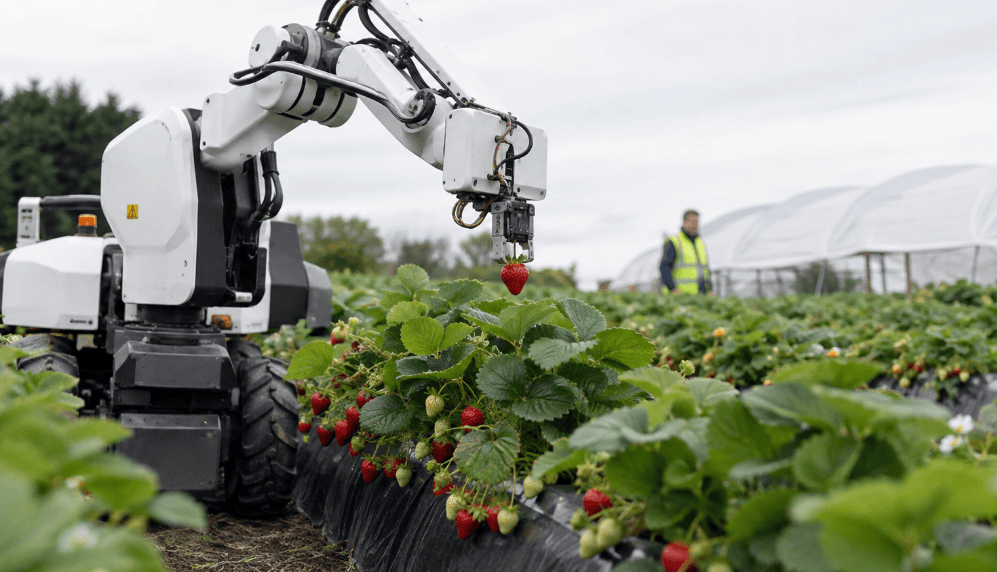
Among the planned facilities is a robotics hub in Newcastle, which will support healthcare providers adopting robotic-assisted surgical procedures. Another centre in Lincoln will focus on agriculture and food production, including automated fruit harvesting and precision farming technologies.
AI and Robotics Minister Kanishka Narayan said harnessing robotics “in every sector of our economy” could “speed up how we reindustrialise the UK”.
The minister announced the £6.3 million HARVEST hub during a visit to the Lincoln Institute for Agri-Food Technology, where researchers demonstrated several agricultural robotics systems.
Narayan said he was “confident” British innovation “can stand the test internationally if we keep up the future of technology”.
Lincolnshire Robotics Hub to Help Farmers Address Labour Shortages
The HARVEST hub will bring together agricultural businesses, technology developers and researchers to encourage the practical adoption of robotics across farming and food processing.
During his visit, Narayan observed automated machines travelling alongside strawberry crops, robotic equipment operating across cultivated fields and a specialised system using concentrated light pulses to destroy weeds.
Such technologies could help farmers reduce dependence on manual labour while improving operational efficiency.
Automated Fruit Picking and Precision Weed Control
Labour availability remains a significant challenge for British agriculture, particularly during seasonal harvesting periods.
Narayan highlighted the potential for robotic technology to support farms facing increasing employment costs and difficulties recruiting workers.
“Farmers are really struggling to be able to find workers to pick fruit when they need them and in some cases that means a big change in the cost, and so clearly that element of farming has changed and the question is how we can support our farmers to stay in business,” he said.
“I’ve witnessed first hand, even in combine harvesters and robotics in dairy farming, how much of a change that’s made in British farming by this technology and I’m hoping today’s announcement will make a big contribution to that.”
Among the technologies demonstrated was Earth Rover’s CLAWS robotic system, which uses bursts of concentrated light to target weeds without conventional mechanical removal.
University of Lincoln Highlights Importance of Agricultural Innovation
Professor Simon Pearson MBE, from the Lincoln Institute for Agri-Food Technology at the University of Lincoln, said the HARVEST hub would connect robotics developers with agricultural and food businesses.
“Industry needs robots to drive productivity, whether it’s on farms or food factory, so the hub will bring the food and robot companies together,” he said.
Pearson acknowledged that automation could help the sector respond to financial pressures, workforce shortages and environmental challenges, although it would not eliminate those difficulties.
“Farming is changing at a phenomenal rate and it’s very difficult with profitability, labour access and climate issues and these technologies won’t resolve those issues but they will help.
“We have world-class food and farming companies in the hub, including Dyson Farming, and to be world-class you’ve got to be internationally competitive and if we don’t do it in Lincolnshire other countries will do it.”
Eight Robotics Adoption Hubs Planned Across the UK
The government has identified eight centres, each focusing on particular industries or applications.
-
Newcastle: Surgical Hub for Adoption of Robotic Practice (SHARP), based at Newcastle Surgical Training Centre, supporting robotic-assisted surgery.
-
Greater South West: Supporting automation in maritime operations, energy and food packaging.
-
Lincoln: HARVEST Hub, concentrating on agricultural robotics and food production.
-
Milton Keynes: Supporting service robots, drones and driverless vehicle technologies.
-
Wales: Hwb Llwybr Roboteg Cymru, helping manufacturing businesses adopt robotics.
-
South East England: National Waste and Recycling Robotics Adoption Hub, focusing on automation in waste management and recycling.
-
Yorkshire: Working with universities in Bradford and Huddersfield to help manufacturers introduce automated systems.
-
Swansea: South Wales Robotics Adoption Hub, supporting small businesses investing in robotics and automation.
The centres are intended to make specialist technologies more accessible to organisations that may lack the resources or expertise to introduce them independently.
Additional £2.5m Funding for Robotics Training and Apprenticeships
Alongside the eight hubs, the government will allocate £2.5 million to 12 projects designed to develop practical robotics training and apprenticeship opportunities.
The initiatives include the Port and Logistics Robotics Adoption Programme in Hull, which will support skills development linked to automation in transport and logistics.
Building Skills for an Increasingly Automated Economy
The training programme will complement the new robotics centres by helping workers and employers develop the technical capabilities required to operate and maintain automated equipment.
For businesses considering investment in robotics, access to skilled personnel will be an important factor in introducing new systems successfully.
The £40 million investment in robotics hubs, alongside additional funding for training, reflects the government’s ambition to expand automation across the UK economy. Its longer-term impact will depend on how effectively businesses and public services adopt the technologies and translate them into productivity improvements.

George Orwell is a writer and contributor covering politics, society, culture, and current affairs. His work focuses on providing clear analysis and thoughtful commentary on the issues shaping modern Britain and the wider world, helping readers better understand complex topics.

