

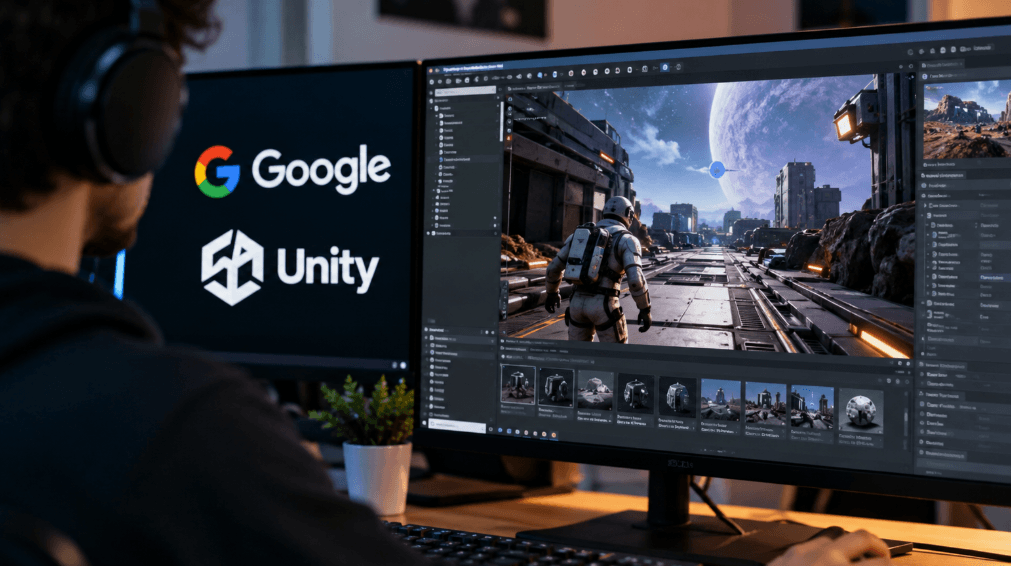

Google and Unity have unveiled new generative artificial intelligence platforms designed to make video game development more accessible through text-based prompts. The announcements introduce two different approaches to AI-assisted game creation, although an early demonstration of Unity’s technology has attracted criticism from established developers.
Google’s experimental platform, Playground, is currently available for testing in the United States, while Unity’s new development tool, Unity Spark, is expected to launch soon.
Both products aim to simplify aspects of game creation, but they differ significantly in their intended audiences and technical capabilities.
Google Playground Aims to Make Game Development Accessible Without Coding
Google Playground allows users to create, play and share games by describing their ideas through written instructions.
The platform is designed for people without programming experience, enabling them to develop relatively simple interactive experiences without learning conventional game development software.
In its announcement, Google explained that game creation has traditionally required specialist technical knowledge and familiarity with complex development engines.
The company said Playground aims to reduce those barriers by allowing users to turn ideas into playable games using a series of prompts.
Integration With Unity Spark Offers More Advanced Development Options
Google also confirmed that Playground will integrate with Unity Spark, providing a route for creators who want to expand their initial concepts.
According to Google, the integration will support more sophisticated gameplay mechanics and higher-quality 3D development capabilities.
This creates a potential progression from basic AI-generated games to more technically advanced projects developed within Unity’s established game engine environment.
However, Google has not explained where Playground obtains the artwork and other assets used to generate its games.
Unity Spark Combines AI Assistance With Traditional Game Development
Unlike Playground, Unity Spark is intended to operate within a more comprehensive development environment.
The platform uses generative AI to assist with tasks through text prompts, while retaining the broader tools and workflows associated with conventional game creation.
Unity chief executive Matt Bromberg discussed the company’s approach in an interview with Gamefile, emphasising that Spark is not intended to produce complete, professional games from a single instruction.
“I’m not denigrating folks who are interested in one-shotting things,” Bromberg said.
“I think there’s a level of excitement and enthusiasm about what the technology can do. And maybe that’s just a way of people celebrating it.”
He added: “Unity Spark is not going to be for everyone. There are many people who don’t have the patience and ambition to make something real.”
Unity Chief Executive Stresses the Importance of Human Creativity
Bromberg also challenged the suggestion that AI-generated content automatically makes someone a skilled game developer.
“Asking the AI to reproduce a game that has already been made does not make you [Hideo] Kojima. It doesn’t make you a famous game developer any more than typing the first paragraph of War and Peace into your word processor makes you Tolstoy.”
His comments underline Unity’s position that generative AI should support development rather than replace the creative judgement and technical expertise required to produce original games.
Unity Spark’s Space Corridor Demonstration Faces Criticism
One of Unity Spark’s principal features is real-time collaboration, allowing multiple users to develop games together.
Unity demonstrated this capability through a promotional video featuring two creators, Mari and Theo, working on a science-fiction shooter called Space Corridor.
The demonstration showed how AI-assisted tools could accelerate development and enable collaborative changes within the game engine.
However, the resulting game attracted criticism for its relatively basic design and lack of originality.
Dan Marshall, developer at Size Five Games and creator of the point-and-click comedy Earth Must Die, criticised the demonstration on Bluesky.
Marshall described Unity Spark’s creation of Space Corridor “as the strongest argument I can think of for keeping game dev out of the pro-AI crowd’s hands”.
Another commenter responded: “They successfully identified that their target market was people with no imagination.”
The reaction highlights concerns among some independent developers that making games easier to produce does not necessarily improve their creativity or quality.
Questions Remain Over AI-Generated Assets and Environmental Costs
During a live demonstration attended by Gamefile, Unity Spark reportedly retrieved development assets from the Unity Asset Store.
However, questions remain about how AI game creation platforms obtain and use visual resources, particularly where ownership and licensing are concerned.
The environmental impact of generative AI was also raised during Gamefile’s interview with Bromberg.
Asked whether Unity could display an estimated carbon footprint alongside AI requests, Bromberg acknowledged that the company had not examined the possibility.
“We hadn’t considered that,” he replied. “That’s something worth considering.”
The exchange raises broader questions about the computing resources required to support increasingly sophisticated AI development tools.
Generative AI Becomes a Growing Priority for Game Engine Developers
Google and Unity are entering a market where other major technology companies are already incorporating generative AI into game development.
Epic Games has announced plans to expand AI capabilities within Unreal Engine, including support for large language models in its current technology.
The company is also targeting deeper integration of language models in Unreal Engine 6.
Meanwhile, Japanese publisher Capcom is developing its proprietary RE Engine through the REX project, which includes work on AI-related capabilities.
These developments suggest that generative AI is becoming an increasingly important consideration for companies developing the software used to build modern video games.
AI Game Creation Raises Questions About the Future of Development
Google Playground and Unity Spark represent different attempts to simplify game creation, from accessible prompt-based experimentation to AI-assisted professional development.
Their introduction could broaden participation in game development and reduce the time required for certain technical tasks.
However, criticism surrounding Space Corridor illustrates the continuing distinction between generating playable content and creating compelling, original games.
As AI tools become more deeply integrated into the industry, their long-term value will depend on whether they genuinely strengthen developers’ creative capabilities rather than simply accelerating content production.

George Orwell is a writer and contributor covering politics, society, culture, and current affairs. His work focuses on providing clear analysis and thoughtful commentary on the issues shaping modern Britain and the wider world, helping readers better understand complex topics.