

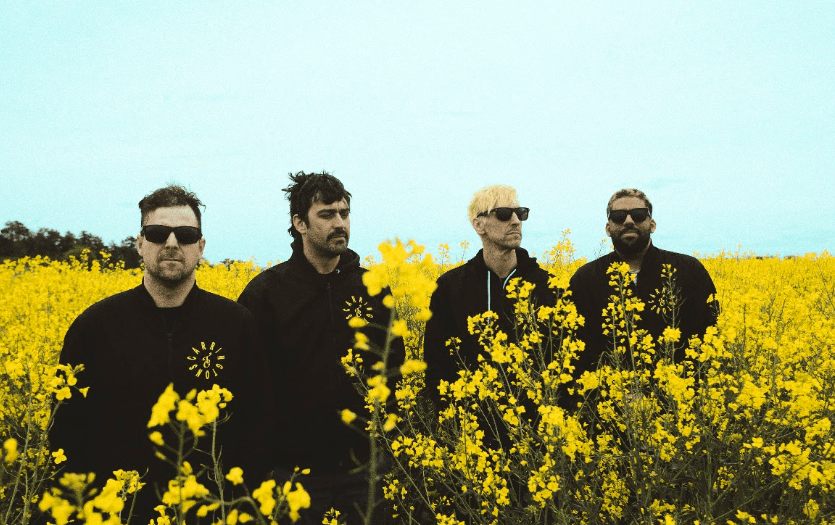
Québec City garage-punk band The Carringtons return with The Reunion, a ten-track album combining sharp guitars, concise songwriting and expansive pop hooks. Released on 2 October 2026, the record arrives 12 years after the group first formed and reflects a band increasingly comfortable pushing its garage-rock foundations into broader territory.
The Carringtons Expand Their Garage-Punk Sound
Drawing on the melodic instincts of The Strokes, the urgency of Bad Nerves, the restless energy of Spiritual Cramp and the carefully constructed garage rock associated with The Hives, The Reunion places immediacy at the centre of its sound.
The formula remains direct: large choruses, memorable hooks and songs that rarely overstay their welcome. Yet beneath that economy, the album shows a noticeable expansion in the band’s production and songwriting.
Recorded and mixed by Adrian Popovich at Mountain City Studios in Montréal, The Reunion introduces synthesisers and electronic textures around the group’s established guitar, bass and drums approach. Layered guitars give several tracks additional weight, while melodies that might previously have been obscured by distortion are brought firmly into focus.
The result is a record with moments capable of fitting comfortably into contemporary rock radio without sacrificing the concise approach that has long characterised the band.
Ten songs move rapidly with little wasted space, maintaining The Carringtons’ preference for arriving quickly, making an impact and moving on.
A Renewed Line-Up and Growing International Reach
That economy has increasingly become part of the band’s identity.
Since regrouping with a tighter line-up and renewed purpose in 2023, Ben Fortier, Joey Savard, Alex Charron and Dave Chamberland have maintained a busy schedule of releases, festival appearances and touring across Canada.
Their ambitions have also extended beyond their home country. In 2026, The Carringtons crossed the Atlantic for eight shows across France, Belgium and the UK, bringing their rapid-fire live approach to European audiences.
The band’s concerts can fit 15 songs into approximately 30 minutes, and The Reunion follows much the same philosophy.
Building on Québec’s Garage-Rock Heritage
The Carringtons emerge from a province with a long history of unruly independent guitar music.
Québec City’s Les Secrétaires Volantes became cult figures during the 1990s, while acts including The Spaceshits, Scat Rag Boosters, Les Sexareenos, CPC Gangbangs and Demon’s Claws contributed to the province’s reputation for raw and self-sufficient garage rock.
That heritage remains audible in The Carringtons’ music, but The Reunion reaches beyond traditional garage-punk boundaries.
Its melodic ambitions also reflect a broader Canadian alternative-rock tradition in which loud guitars and unconventional ideas have often been paired with accessible pop songwriting.
Adrian Popovich Helps Broaden the Production
Producer Adrian Popovich appears particularly well suited to that progression.
A former member of Canadian garage-rock group Tricky Woo and guitarist and vocalist with American Lips, Popovich has spent decades working both as a musician and behind the recording desk. His recording and production credits have connections with artists including Sam Roberts, The Dears and Sebastien Grainger.
On The Reunion, electronic instruments and less expected textures are incorporated without overwhelming the band’s fundamental guitar-driven attack.
Creative director Hugo Mudie, the longtime frontman of The Sainte Catherines, also contributed to refining arrangements and ideas, while Marc-André Beaudet mastered the completed album.
Together, the team has helped The Carringtons develop a sound positioned between garage punk, indie rock and power pop, while allowing the band’s more mature songwriting to remain prominent.
“Emptiness” Highlights the Album’s Evolution
Release-week focus track “Emptiness” provides one of the clearest examples of that development.
Running for exactly two minutes, the song explores the emotional weight of regret and the sense of being hollowed out by past experiences. Its narrator is left almost ghost-like amid the aftermath before the track opens into one of the album’s biggest refrains: “I would like to start a revolution, but I lost my mind somewhere.”
The song retains the immediate quality associated with The Carringtons’ shorter punk tracks, but its emotional and musical scope suggests a band working with a wider palette.
That contrast continues throughout The Reunion. Song titles including “Trust,” “Hope,” “Romance,” “Isolation” and “Obsession” point towards heavier themes and a different perspective from the band’s earlier material.
Rather than responding to those subjects by slowing down, The Carringtons continue to rely on melody, distortion and tightly controlled momentum. Electronic elements broaden the arrangements, while the choruses are given considerably more space and impact.
The Reunion Marks a New Chapter for The Carringtons
Despite its title, The Reunion is less concerned with nostalgia than with what happens after a band finds its way back together.
The Carringtons have already completed the reunion itself. Their latest album instead captures the next stage: four musicians retaining the immediacy, hooks and DIY instincts that shaped their early years while becoming increasingly confident about making those ideas sound bigger.
Twelve years after forming, The Carringtons have not abandoned their garage-punk roots. With The Reunion, they have instead found more room to build around them.

George Orwell is a writer and contributor covering politics, society, culture, and current affairs. His work focuses on providing clear analysis and thoughtful commentary on the issues shaping modern Britain and the wider world, helping readers better understand complex topics.

