

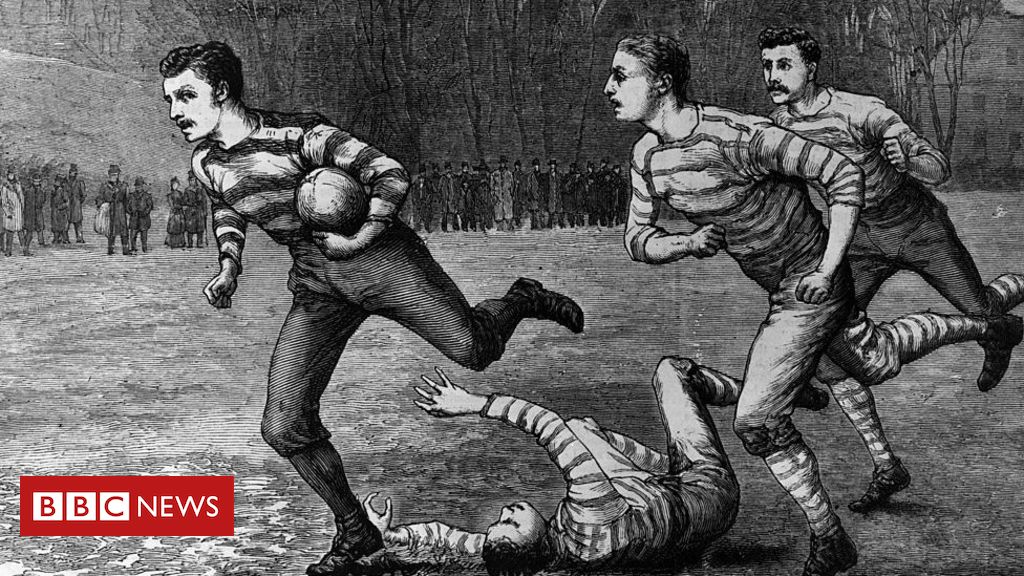
credit, Getty Images
Although it was played in many of the colonies of the British Empire, football did not achieve the same amount of popularity in many of these locations.
Football, the most popular sport on the planet, was essentially born in a pub in England in 1863, when some individuals decided to establish rules for a game that was already regularly played in that country, with the idea of distinguishing it from other sports that were very popular there: the game Rugby.
The truth is that in less than four decades, football has already existed in many countries around the world.
One of the reasons for this spread was that this sport was born in the most powerful power on the planet at that time: the United Kingdom, which controlled large areas around the world.
However, football is not currently the most played or followed sport in many areas of the once powerful British Empire.
In Australia, New Zealand and South Africa, for example, rugby is much more popular than football, while in India and Pakistan cricket is almost a religion.
“What happened with Australia or India is that when the British arrived, the national sport in England was cricket, not football. Rugby was the sport of choice for the aristocrats who were sent to rule these places,” explains sports historian Jan Williams.

credit, Jimmy McDonald
Football is undoubtedly the most popular sport in the world
Williams explains that football was a middle and working class sport in the United Kingdom at the time.
“The spread of football in the world occurred for two reasons: first, the spread of railways built by English engineers, and second, the academic exchange that took place with people from other countries, especially from Latin America and Asia,” Williams points out. .
Cricket and Rugby: The Sport of Empire
Cricket is a bat-and-ball sport (like baseball, but with fundamental differences in placement and strategy) played on an oval field where the main objective is to score runs (points).
The sport, with its roots in the Middle Ages, became the national sport of England from the 18th century onwards, and of course during the height of the British Empire.
Added to this is the popularity of another sport: rugby, which for decades was considered a “gentlemen's sport.”
“These sports were concentrated in the upper classes and leaders of the time. What they did was almost officially introduce them to areas like Australia, India or South Africa,” says Williams.

credit, Getty Images
Rugby became popular in the United Kingdom among the upper classes
Although British traders brought cricket to India in the 17th century, it was the conquest of these lands in the mid-19th century that finally gave the sport the recognition it maintains there today.
Something similar happened with rugby, which also began to become very popular in the mid-nineteenth century, especially in Oceania and South Africa.
Historian Patrick Hutchinson notes in the article that “sport in the British Empire served as a unifying force, was often imbued with nationalist rhetoric, and served as a climate-focused representation of social and political struggle.” Sports and British colonialism (“Sports and British Colonialism,” free translator).
This influence has made India and Pakistan – and Australia – current cricketing powers.
In rugby, the only men's teams to be crowned world champions other than England are New Zealand, South Africa and Australia, all former British colonies.
In fact, the most popular sport in Australia is Australian rules football, which is a mixture of cricket, rugby and soccer, and is very similar to the early version of English rugby.
Furthermore, football had two characteristics that alienated it from those colonial areas: it was codified late (in 1863), and it had roots in the British middle and working class.
“By the time football became the most popular sport in the UK, cricket and rugby had already become widespread in the colonies and were still the favored sports of the upper classes and aristocracy,” explains Williams.
But this does not mean that the imperial authorities did not use football as a “unifying force”, especially in the British colonies in Africa.

credit, Matthew Lewis
Cricket is the most popular sport in India
“In Zanzibar, Egypt and elsewhere, leagues were created with the aim of exercising a form of control through sport. Football was used for this purpose,” Hutchison says.
But the sport also had other ways to expand.
further than the railway
At the beginning of the twentieth century, the major world power was still the British Empire, which extended across Africa, Asia and the Caribbean.
In Europe, this sport has become very popular thanks to the presence of expatriates who have traveled to different countries such as Germany, France, Italy and Spain.
However, in other latitudes, one of the main forms of influence was the construction of railways, a British invention.
“Many believe that it was railway workers who transported football around the world,” says the academic. “But in fact, it was engineers, because football was a middle-class sport in England.”
According to Williams, these professionals were influential enough not only to practice the sport, but also to teach and implement it in an organized manner in these countries, as the aristocrats had done through cricket and rugby colleges in the colonies.

credit, Getty Images
Some clubs in Latin America keep their names with the English words with which they were founded
At the beginning of the 20th century, especially in Brazil, Argentina and Uruguay, the first clubs began to be created, many of which have English names that still survive: River Plate or Boca Juniors (Argentina); Club Nacional de Futbol (Uruguay) and Club Fluminense (Brazil), for example.
“What happened with football is that it was no longer divided into categories, but became popular at all levels [na América Latina]“Williams explains.
But the expert highlights that railways were not the only means of spreading football around the world: students and visitors to the UK were a widespread means of spreading the sport.
“A lot of people who left Latin America or Asia to study at an English university saw that the sport was very popular and wanted to bring it back to their home countries,” says Williams.
There is no shortage of examples: Deportivo Cali, one of the more traditional Colombian clubs, was founded by the Nazario brothers, Juan Pablo and Fidel Lallende Caldas, who traveled to the United Kingdom at the beginning of the 20th century and spent around five years there.
Charles Miller himself, who is considered responsible for bringing football to Brazil at the end of the 19th century after studying in England, was the son of a Scottish engineer who worked on the railways in the state of São Paulo.

credit, Victor Moriyama
Football continues to captivate thousands of children around the world
“Football was born in England and became something that people who lived outside the British Empire aspired to, and many football clubs were founded by people who traveled to the UK,” he says.
But there were areas where there was British influence, such as the United States or Canada, where football also failed to take root.
“Soccer has tried to enter American culture several times, but the rules and number of goals are not conducive to the sport's popularity,” says James Brown, of the Association of Soccer Historians in the United States.
For Brown, Americans love contact sports with dynamic outcomes, where higher scores can be achieved.
“But the reality is that until the age of 16, soccer is the most played sport among American youth. Therefore, there is a future for this sport in the country.”

“Food fanatic. Organizer. Hipster-friendly tv specialist. Avid reader. Devoted web ninja.”