

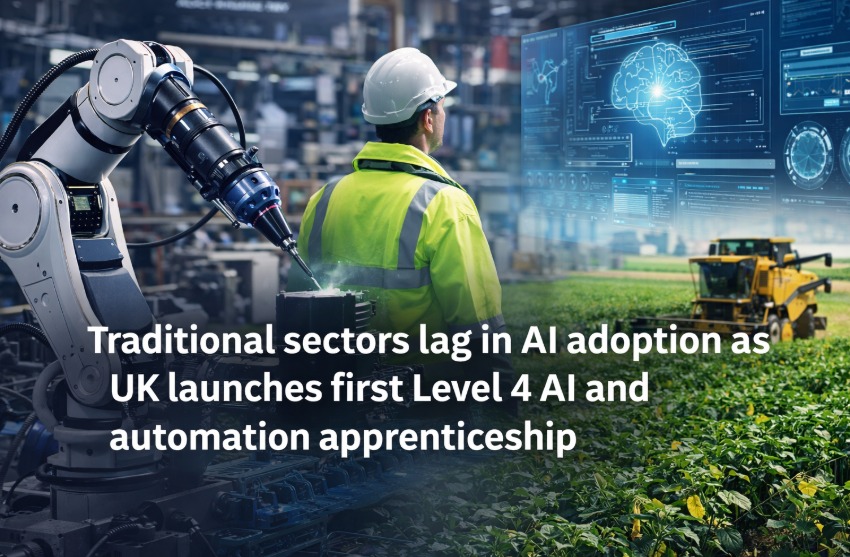
Traditional UK industries including transport, construction, manufacturing and agriculture continue to lag behind in artificial intelligence adoption, despite record levels of interest across the wider economy, according to new research released as the country launches its first Level 4 AI and Automation Apprenticeship Standard.
The findings highlight a growing divide between knowledge-intensive sectors that are already embedding AI into day-to-day operations and smaller firms in more traditional industries that are struggling to move beyond experimentation. While up to 70% of UK businesses are either using or actively considering AI, adoption is heavily concentrated in IT, communications, professional services, finance, and health and life sciences.
The research suggests that the slower take-up among SMEs is not driven by a lack of ambition, but by practical barriers that make implementation difficult. The most commonly cited obstacle is difficulty identifying relevant use cases, with 39% of businesses saying they struggle to determine how AI could be applied to their operations. Cost concerns were the second biggest issue at 21%, followed by a lack of internal AI skills and expertise at 16%.
For many smaller firms, particularly microbusinesses, the gap between interest and action remains wide. Nearly half of UK microbusinesses say they do not expect to use AI at all, while only around 12% of SMEs have invested in formal AI training to date. The data points to a market where enthusiasm exists, but where confidence, capability and accessible support are still in short supply.
In response, digital skills provider The Coders Guild has worked with Skills England and the Department for Education to author what it describes as the UK’s first Level 4 AI and Automation Apprenticeship Standard. The programme is intended to give employers a structured route to building in-house AI capability, particularly in sectors where adoption remains low.
The Coders Guild said the new apprenticeship marks a milestone in developing a workforce able to harness AI in “practical, commercially valuable ways”, as the pace of adoption accelerates and businesses face increasing pressure to improve productivity and competitiveness.
The 18-month apprenticeship is available to both employers and learners and is designed to equip apprentices with the skills to identify, implement and manage responsible AI and automation projects. Apprentices will be trained to spot real-world opportunities, deploy AI tools safely and ethically, and embed automation strategies that deliver measurable business impact.
The programme arrives amid growing evidence that SMEs are actively seeking more support to make AI workable. Research commissioned by The Coders Guild found that 68% of SMEs want access to more affordable AI solutions, while 51% say they need hands-on support to implement AI effectively. However, more than half of SMEs surveyed — 52% — cited skills shortages as a key barrier to adoption.
The research also reinforces a sectoral imbalance. IT, communications, finance and health and life sciences are leading the way in adoption, while transport, construction and manufacturing remain among the slowest-moving areas, suggesting that broad innovation initiatives may be failing to address the specific needs of operational and asset-heavy industries.
Crispin Read, founder of The Coders Guild, said the data showed a concerning level of disengagement among the smallest firms.
“Our findings show that nearly half of UK microbusinesses say they don’t expect to use AI at all. As a small business leader who’s seen real gains in efficiency and profitability from AI, that’s deeply concerning. The gap between what’s possible and what most SMEs are experiencing is significant.”
Read said the apprenticeship is designed to make AI feel more achievable for businesses that currently see it as complicated or risky.
“This apprenticeship is about giving SMEs the confidence and capability to adopt AI in a way that genuinely delivers value. For many businesses, especially in traditional industries, AI still feels complex, risky or out of reach. With the right training, you can put someone in your team who not only understands how to use AI effectively, but can also support and upskill colleagues across the business.”
He added that AI and automation can unlock productivity gains while helping companies deploy staff time more effectively.
“The result is greater efficiency, time savings and smarter use of data – freeing people up to focus on higher-value work. Most importantly, it future-proofs businesses. AI is moving fast, and SMEs cannot afford to be left behind. This programme creates in-house leaders who can drive sustainable change.”
The Coders Guild said the apprenticeship will directly target the barriers holding back adoption by training employees who can lead on identifying opportunities, deploying practical AI tools and embedding automation strategies across their organisations.
With policymakers increasingly focused on improving national productivity and supporting growth in the SME economy, initiatives that combine technical training with real-world implementation may play a growing role in helping firms modernise. The new apprenticeship standard is positioned as a way to move beyond awareness and experimentation, giving businesses the capacity to deploy AI in ways that deliver tangible outcomes.
UK SMEs interested in the apprenticeship can now pre-apply through The Coders Guild’s website.

George Orwell is a writer and contributor covering politics, society, culture, and current affairs. His work focuses on providing clear analysis and thoughtful commentary on the issues shaping modern Britain and the wider world, helping readers better understand complex topics.

