

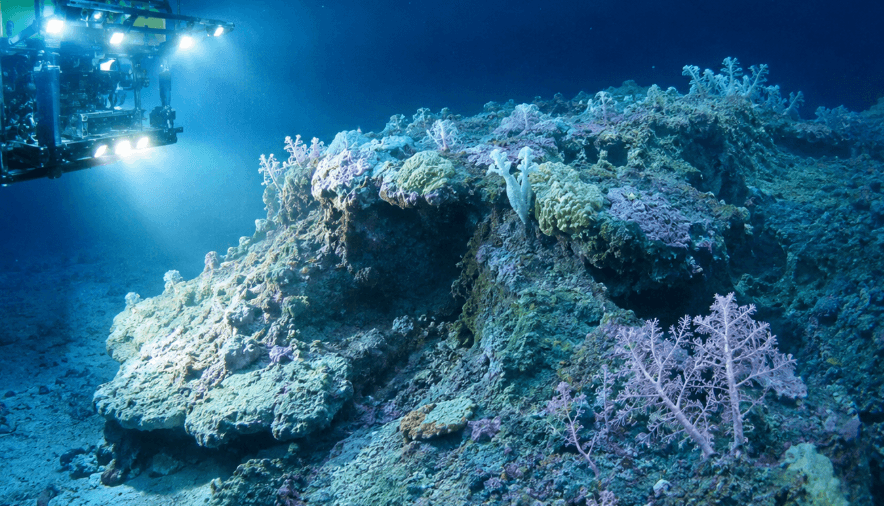

Scientists have discovered an ancient submerged coral atoll on the Mid-Atlantic Ridge, providing new evidence of prehistoric reef systems in a region where no coral atolls exist today. The discovery also reveals a remarkable variety of marine life thriving in some of the Atlantic Ocean’s deepest environments.
Ancient Coral Atoll Discovered on Mid-Atlantic Ridge
A Brazilian-led research team working with the Schmidt Ocean Institute identified the fossilised coral formation during a deep-sea expedition. The discovery was announced on 23 November from Fortaleza, Brazil.
Estimated to be around five million years old, the submerged atoll stands approximately 300 metres tall, making it nearly as high as the Eiffel Tower. Its highest point lies around 900 metres beneath the ocean’s surface.
The formation sits atop a volcanic ridge rising approximately 4,100 metres from the surrounding seabed within the Romanche Fracture Zone, a geological fault extending around 950 kilometres near the equator.
Researchers have suspected for approximately three decades that coral atolls once existed in this part of the Atlantic. The discovery provides physical evidence supporting that theory.
Understanding the Romanche Fracture Zone
The Mid-Atlantic Ridge is an extensive underwater mountain system where tectonic plates move apart, allowing new oceanic crust to form.
The Romanche Fracture Zone connects sections of the ridge and is characterised by tectonic plates moving horizontally past one another.
The region is also an important meeting point for Antarctic Bottom Water and North Atlantic Deep Water. These cold ocean currents help shape deep-sea environmental conditions, while organic material sinking from surface waters provides nutrients for marine organisms.
Scientists have long considered the area a potential hotspot for marine biodiversity, although its ecosystems had not previously been directly examined using a remotely operated underwater vehicle.
How the Ancient Coral Island Became Submerged
The formation of coral atolls is closely associated with a geological theory developed by British naturalist Charles Darwin.
Atolls typically develop around volcanic islands, where coral reefs grow along the coastline. As volcanic activity ceases and the underlying land gradually subsides, coral can continue growing towards the surface, eventually forming a ring-shaped reef surrounding a lagoon.
However, shallow-water reef-building corals depend on sunlight. If subsidence occurs faster than coral growth, the reef can become submerged beyond the depths necessary for survival.
Researchers recovered fossilised shallow-water coral from the Atlantic formation, indicating that it once existed much closer to the ocean’s surface.
The precise circumstances and timing of its submergence remain unclear. Its estimated age of five million years also awaits further published scientific analysis.
Underwater Robots Help Scientists Explore the Ancient Reef
The discovery was made during a 35-day expedition aboard the Schmidt Ocean Institute’s research vessel, Falkor (too), which concluded in October.
Scientists used advanced seabed mapping equipment and an autonomous underwater vehicle named The Childlike Empress to identify the formation.
Advanced Technology Captures Deep-Sea Footage
Following the initial mapping survey, researchers deployed SuBastian, a remotely operated vehicle equipped with high-definition cameras.
The underwater robot weighs approximately 3.2 tonnes, measures around 2.7 metres in length and can operate at depths of approximately 4,500 metres.
Unlike autonomous underwater vehicles, SuBastian remains connected to the research vessel through a tether, allowing operators to control its movements and observe underwater environments in real time.
Remarkable Marine Ecosystems Found Beneath the Atlantic
Despite the disappearance of its original shallow-water reef, the ancient atoll now supports a thriving deep-sea coral garden.
Researchers also documented dozens of vulnerable marine ecosystems across four sections of the fracture zone, including coral gardens, sponge communities and unusual marine organisms.
Among the most significant discoveries was a meadow of pale pink zoanthids at approximately 1,190 metres below the surface, covering an area comparable to a football pitch.
Cold-water corals and sponges were recorded at around 1,680 metres, while mushroom-shaped soft corals belonging to the genus Anthomastus were observed at approximately 2,830 metres.
Another remarkable coral and sponge community was discovered at a depth of around 4,300 metres, considerably deeper than researchers had expected to encounter large concentrations of these organisms.
Some corals are estimated to be around 1,000 years old.
Paulo Sumida, a professor at the University of São Paulo who participated in the expedition, said: “Everywhere we looked, we saw stories emerging.”
Discovery Strengthens Case for Deep-Sea Conservation
Chief scientist Jose Angel Perez, from Brazil’s Universidade do Vale do Itajaí, believes the expedition has collected enough scientific data to support decades of further research.
Researchers suspect that some recovered specimens may represent previously unidentified species, although laboratory analysis is required to confirm their findings.
The discoveries could also strengthen the case for protecting the Romanche Fracture Zone under the United Nations High Seas Treaty.
The expedition highlights the extraordinary biodiversity of largely unexplored ocean environments, offering valuable insights into the Atlantic’s geological history and the importance of protecting fragile deep-sea ecosystems.

George Orwell is a writer and contributor covering politics, society, culture, and current affairs. His work focuses on providing clear analysis and thoughtful commentary on the issues shaping modern Britain and the wider world, helping readers better understand complex topics.