

CAMBRIDGE, England — Wearable technology is set to play a growing role in the global shift toward digitalisation, enabling more continuous health monitoring, stronger personal wellbeing insights and new forms of accessibility, according to research firm IDTechEx.
In a statement released Friday, the Cambridge-based company highlighted how body-worn devices are increasingly being used to collect, communicate and interpret health data in real time. The firm said its portfolio of Wearable Technology Research Reports and Subscriptions tracks a broad range of sensor technologies and applications, reflecting the expanding commercial opportunities in digital health, consumer electronics and assistive technology.
IDTechEx’s latest outlook points to continued steady growth in wearable sensors over the next decade. The company predicts the wearable sensors market will reach US$7.2 billion by 2035, representing a combined compound annual growth rate of 5% between 2025 and 2035.
The forecast suggests demand for wearables will extend beyond fitness tracking, with growth increasingly tied to clinical monitoring, workplace safety, digital therapeutics and enhanced human-computer interaction.
Diabetes devices show how wearables support daily health management
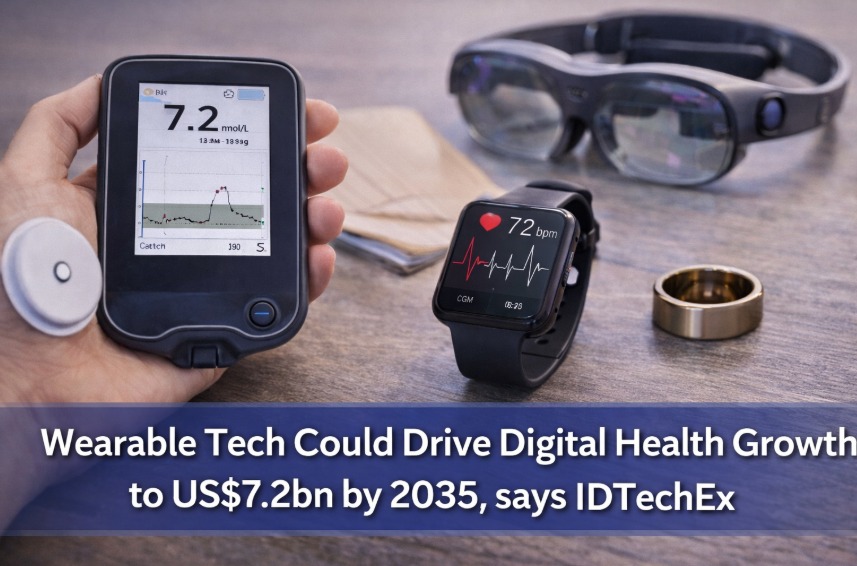
IDTechEx pointed to diabetes management as a clear example of how wearable devices are changing how health data is collected and used. Continuous glucose monitoring (CGM) systems, in particular, were cited as a practical application where sensors and connected software provide continuous insight without disrupting daily routines.
CGMs allow users to receive blood sugar readings through smartphone applications, enabling alerts when insulin may be needed. The model reduces reliance on traditional finger-prick testing and can support more consistent monitoring throughout the day.
According to IDTechEx, CGMs demonstrate how wearables can provide a channel not only for personal health awareness but also for longer-term data accumulation. The data stored over time can reveal patterns and trends, potentially improving individual decision-making and contributing to broader industry understanding.
The firm’s report “Wearable Sensors Market 2025-2035: Technologies, Trends, Players, Forecasts” examines CGMs within a larger wearable sensing landscape. IDTechEx said that market includes motion, optical, force and strain, temperature, chemical and quantum sensors, as well as electrodes — reflecting how wearables are increasingly defined by multi-sensor integration rather than single-purpose hardware.
Smartwatches and rings expand biometric monitoring into the mainstream
While CGMs remain a high-value health-focused segment, IDTechEx also highlighted the scale of consumer wearables already in everyday use.
Smartwatches remain among the most widely adopted devices, used to track biometrics such as heart rate, step count and sleep quality. The category has expanded rapidly over the last decade as device prices have declined, sensors have improved, and health-related features have become a core selling point for consumers.
IDTechEx also pointed to smart rings as a growing product segment, combining a discreet design with accurate health tracking via connected applications. These devices can capture sleep, activity and other biometrics, and in some cases support fertility-related insights for women.
The firm suggested that the market’s continued growth will be supported by broader consumer comfort with wearable devices, along with an increasing expectation that personal health data can be monitored continuously and interpreted through software.
Wearables increasingly positioned as accessibility tools
Beyond health monitoring, IDTechEx said wearable devices are also enabling new accessibility applications, particularly through smart glasses and augmented reality (AR) features.
The company highlighted real-time narration and transcription as an example of how AR glasses could support people who are hard of hearing. In this use case, speech could be converted into text displayed on lenses, helping users follow conversations without missing details.
Such applications signal an expanding role for wearables in workplace communication and inclusion, particularly in settings where real-time information access can improve productivity and safety.
Virtual and mixed reality continue to develop beyond entertainment
IDTechEx also identified virtual reality (VR) and mixed reality (MR) headsets as a significant wearable category, driven largely by entertainment but with broader potential for training, education and accessibility.
The firm noted that these devices typically involve trade-offs, including increased weight and battery limitations, but can provide highly immersive experiences through improved image clarity and wide fields of view.
Its report “Optics for Virtual, Augmented and Mixed Reality 2026-2036: Technologies, Forecasts, Markets” explores these technologies across both consumer and practical use cases, reflecting ongoing investment in optical systems and display performance.
Brain-computer interfaces point to longer-term disruption
Looking further ahead, IDTechEx pointed to brain-computer interfaces (BCIs) as an emerging area where wearable technology could deliver new levels of accessibility for users who require support with movement and communication.
BCIs can interpret brain signals with varying degrees of invasiveness and translate them into commands that control external devices. The technology relies on electrodes or sensors to detect neurological activity, enabling interaction without conventional physical input.
IDTechEx’s report “Brain Computer Interfaces 2025-2045: Technologies, Players, Forecasts” examines the market landscape, signalling a longer-term commercial opportunity alongside complex regulatory and technical challenges.
IDTechEx said its wearable technology research portfolio provides further analysis of how devices are bridging the gap between humans and computers, while expanding the role of digital health data in both consumer and clinical settings.

“Friendly zombie fanatic. Analyst. Coffee buff. Professional music specialist. Communicator.”

