


Access to personal health data around the clock is fast becoming mainstream as wearable technology moves beyond step counters and into continuous monitoring of vital signs, according to new analysis from research firm IDTechEx.
In a press release issued on Monday 26th January 2026, the Cambridge-based company highlighted growing interest in devices that can track biometrics throughout the day and night, alongside emerging display-driven wearables such as smart glasses and early-stage brain-computer interface systems.
IDTechEx said its portfolio of Wearable Technology Research Reports is focused on the expanding range of technologies now being deployed in consumer and medical-grade wearables, and how these devices could reshape health management, remote monitoring and the way people interact with information.
At the heart of the trend is the ability of wearables to sense and collect biometric data continuously. Unlike traditional medical measurements taken during occasional appointments, wearables can remain close to the body for extended periods, generating a richer stream of data that can be reviewed over time.
“The vast array of technologies and device types all differ in their capabilities, each providing means of either sensing, actuating, displaying, or communicating,” IDTechEx said. It added that key measurements include “glucose, heartrate, respiratory rate, blood pressure, blood oxygen, and motion”.
The company pointed to “continuity” as a major focus across the sector, enabled by form factors such as smartwatches, rings and skin-mounted patches. These devices, it said, are increasingly capable of collecting data without disruption to the wearer’s daily routine, helping users build a more consistent picture of their health.
Among the technologies driving that shift are optical sensors, which can measure physiological changes by analysing how blood absorbs light. IDTechEx said optical sensors can detect heart rate and blood oxygen, while also providing insight into cardiovascular conditions by monitoring changes in blood flow and vessel size.
Electrodes represent another approach, the firm noted, measuring electrical signals at the skin’s surface that correlate with brain and muscle activity, including the heart. These methods are being integrated into a widening range of devices, including smartwatches and clinical-style patches designed for longer-term use.
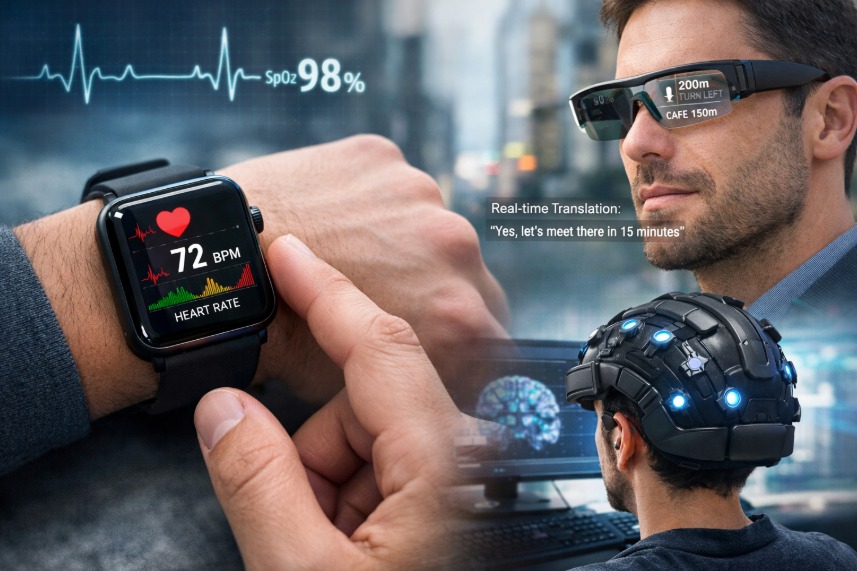
Smartwatches remain a key category due to their combination of sensing and connectivity. IDTechEx said these devices can deliver “messages, notifications, and health data including step count and heartrate, handsfree to the wrist of users”, when paired with a smartphone. The firm suggested that widespread adoption is helping users stay more aware of their physical condition, whether for medical monitoring or everyday wellbeing.
Remote patient monitoring is also gaining momentum, with wearables increasingly positioned as a way to collect health data “around the clock rather than at certain intervals or appointments”. IDTechEx said data gathered by smartwatches and skin patches can be stored in smartphone apps, allowing trends to be analysed over longer periods and potentially improving accuracy and context.
The company referenced its report titled “Wearable Sensors Market 2025-2035: Technologies, Trends, Players, Forecasts” as a deeper look at the commercial outlook and technology landscape for wearable sensing.
Diabetes management is one area where continuous data capture is already proving valuable, particularly through patches that measure blood glucose levels. IDTechEx said “Skin patches equipped with a small needle to reach interstitial fluid in order to take blood sugar readings can also offer similar communication and data storage benefits.”
By connecting to a smartphone, these systems can alert users to changes in glucose levels and help them respond more quickly. “Linked to a user’s smartphone, people managing diabetes can be informed when they may require insulin,” the company said.
IDTechEx also linked the development of digital health tools and artificial intelligence to pressures on healthcare services, suggesting that data-driven systems could support decision-making and reduce strain. It pointed to its report “Digital Health and Artificial Intelligence 2024-2034: Trends, Opportunities, and Outlook” for further detail on market opportunities.
Beyond sensing, IDTechEx highlighted wearables designed primarily for display and information delivery, particularly smart glasses. The company said features such as “Real time translations and visual narration” could support people who struggle to hear or follow conversations by presenting dialogue on lenses.
It also described the potential for glasses to provide navigation support when connected to a smartphone, enabling users to access directions without looking down at a handset. IDTechEx argued that overlaying digital information onto the real world “may be revolutionary in changing how people go about their lives”, with smart glasses offering a more discreet interface.
Another emerging segment is brain-computer interfaces, where developers are working to interpret brain data using wearable systems. IDTechEx highlighted magnetoencephalography (MEG) helmets, which can measure magnetic fields generated by neural activity. While the technology has traditionally been limited to large, stationary scanning equipment, the company said efforts are under way to integrate it into more mobile helmet-based formats.
However, it noted that further development is needed to ensure performance is not compromised as the technology becomes more portable. The firm cited its report “Brain Computer Interfaces 2025-2045: Technologies, Players, Forecasts” as an overview of other wearable approaches that could eventually offer more accessible neural insights.
IDTechEx said it expects continued near-term growth in wearable adoption, driven by demand for continuous monitoring, improved connectivity and new display applications. It encouraged readers seeking market forecasts and technology updates to explore its research portfolio focused on wearable technology.

“Friendly zombie fanatic. Analyst. Coffee buff. Professional music specialist. Communicator.”