

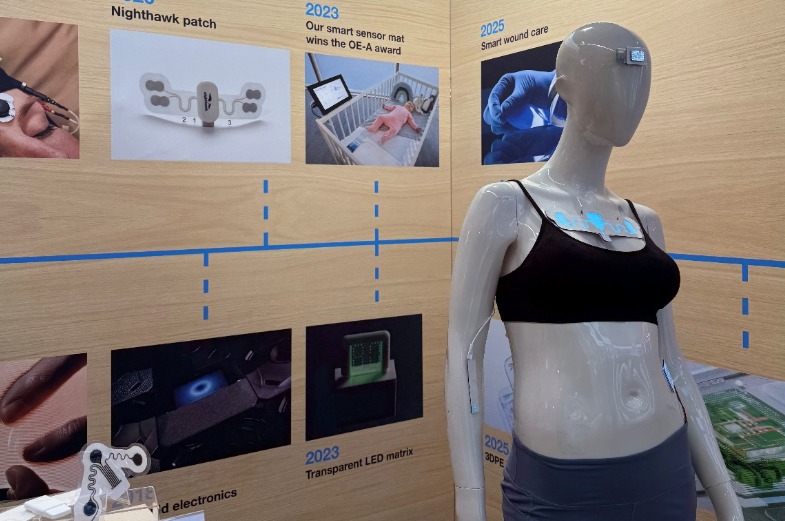
Advances in printed sensing technologies promise thinner, more discreet health monitoring devices
Printed electronics are increasingly shaping the future of medical wearables, enabling thinner, more flexible devices capable of tracking key health metrics with greater comfort and discretion, according to insights released by IDTechEx following its attendance at LOPEC 2026.
The Cambridge-based technology research firm said the exhibition highlighted how advances in printed electronics are allowing manufacturers to produce streamlined medical devices capable of monitoring a wide range of biometrics while improving user comfort and accessibility.
Producing streamlined devices to measure a number of medical biometrics and creating modern and efficient wearable products are some of the latest achievable possibilities with printed electronics. With many companies having exhibited at LOPEC 2026 where IDTechEx recently attended, the broadening landscape of exciting new technologies, both developmental and commercialised, is becoming evident.
The role of printed electronics within the medical and wearables sectors in particular is increasingly notable, as variables including heart rate and rhythm, temperature, and glucose levels, to name just a few, can all be measured discreetly with streamlined patches. IDTechEx’s portfolios of Printed & Flexible Electronics Research Reports and Wearable Technology Research Reports are home to some of the latest research within the sectors.
Expanding medical applications for printed electronics
A range of companies and research organisations at LOPEC 2026 demonstrated emerging applications that highlight the expanding role of printed electronics in healthcare monitoring.
Companies like Beneli work to create products right from an initial design and offer services throughout the entire value chain. With the use of 2D printed electronics, extremely thin sensing technology can be printed onto transparent, thin, and stretchy fabric, to comfortably conform to the body.
Such innovations are opening new opportunities for remote patient monitoring. ECG monitors and glucose monitoring patches in particular could help to make remote patient monitoring more accessible, while their discreet and streamlined form factor will make them less noticeable and more appealing to use.
Research institute Holst Centre also showcased its Nighthawk patch, which aims to deliver higher quality electrocardiogram readings using advanced electrode technology. Developments such as these reflect growing demand for continuous monitoring tools that can be worn comfortably for extended periods.
Printed sensing technologies are also expanding beyond conventional monitoring. Beneli demonstrated a brain scanning technology printed on a stretchable, adhesive substrate. IDTechEx’s report, “Brain Computer Interfaces 2025-2045: Technologies, Players, Forecasts”, explores the emergence of brain scanning technologies, including MEG helmets, that can take readings while people are able to move and interact instead of simply lying still with no external stimuli to engage with.
In such settings, results with can be achieved with higher comfort levels for patient, while scans taken during daily activities could potentially provide more accurate, contextualized results.
Other companies are targeting specific post-surgical monitoring challenges. Witte Technology presented ostomy sensors designed to detect leaks following operations. Meanwhile, Biotronis is developing printed sensors that could potentially be implanted inside the body to monitor risks after anastomosis surgery.
The company reported that 2.7 billion euros is spent annually in Germany on procedures linked to anastomosis surgery, underlining the potential healthcare cost benefits of improved monitoring technologies.
Materials innovation enabling next-generation devices
Beyond device design, the LOPEC exhibition also highlighted the growing importance of materials science in enabling new wearable healthcare technologies.
Henkel demonstrated how its conductive ink technology is being used across a range of medical and wearable applications. The company displayed several products produced with its conductive inks, including Covid test strips and adult diapers equipped with moisture-detecting sensors.
Conductive inks are also being used in the wearable clothing sector. Flexible heated garments, including jackets and coats designed for military personnel operating in cold environments, were among the applications highlighted during the exhibition.
As wearable health technologies evolve, the integration of sensors into everyday products is expected to expand significantly. IDTechEx’s report, “Wearable Sensors Market 2025-2035: Technologies, Trends, Players, Forecasts”, examines the growing intersection between sensing technologies and consumer wearables.
Among the emerging innovations discussed are piezoelectric pressure sensors embedded in shoe insoles. These sensors monitor movement and provide step feedback that could help detect problems with foot positioning.
VFP Ink Technologies and Hochuen Tech both demonstrated this technology at LOPEC 2026, with potential benefits for individuals managing diabetes, where early detection of foot-related complications is critical.
Growing ecosystem for wearable health technologies
The developments showcased at LOPEC 2026 suggest the ecosystem surrounding printed electronics is rapidly expanding, encompassing device manufacturers, materials providers and healthcare technology developers.
For medical device companies, the ability to integrate sensors into flexible substrates and fabrics opens the door to less intrusive and more patient-friendly monitoring tools. For healthcare providers, these innovations could support improved remote monitoring and earlier detection of potential health risks.
As printed electronics continue to evolve, IDTechEx expects the technology to play an increasingly important role in the development of next-generation medical wearables and connected health systems.

“Friendly zombie fanatic. Analyst. Coffee buff. Professional music specialist. Communicator.”

