

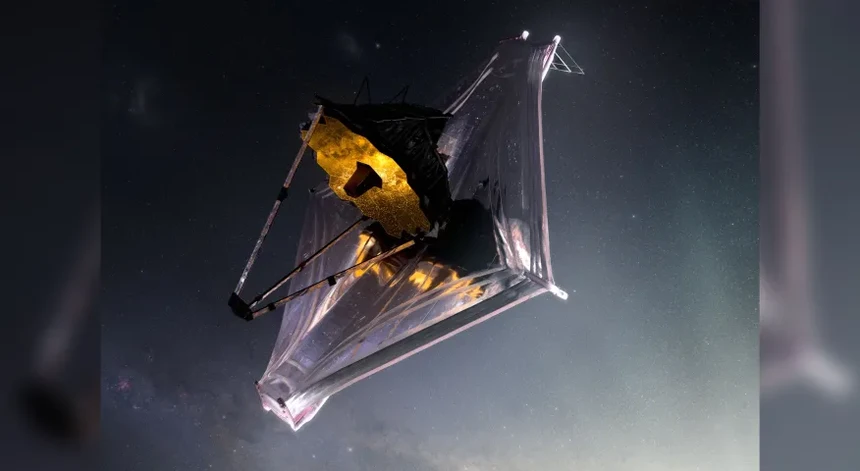
US President Joe Biden said during an event at the White House, six months after the launch of the most powerful space telescope ever made, that the first color science image from the James Webb Telescope marks a “historic” day.
this picture “The deepest and clearest infrared image of the universe everthe US space agency highlighted.
Light is divided into different wavelengths, including infrared, which, unlike James Webb, designed for this purpose, the human eye cannot perceive.
The released image shows thousands of galaxies, but “a grain of sand on the tip of a finger and the arm stuck,” according to the analogy given by NASA Administrator Bill Nelson, who referred to the depicted space as “a small part of the universe.”
The moment captured and released now points to the galaxy cluster SMACS 0723, whose presence in the foreground magnifies and distorts the light of objects behind them, allowing deep-field views of very distant galaxy clusters, an effect called a gravitational lensing.
Launched into space on December 25, 2021, the James Webb Space Telescope has traveled to orbit 1.5 million kilometers from Earth and is now beginning to collect images of distant places in the universe, after a complex process of instrument calibration, and mirror alignment.
The first color images and spectra obtained by the James Webb Space Telescope indicate five cosmic objects, including one of the largest and brightest nebulae and a giant planet outside the solar system, as explained by the European Space Agency (ESA) on July 8. The largest and most powerful space telescope has been in orbit since January.
The unveiling of the images marks the beginning of James Webb’s science operations, which bring together the cooperation of the European Space Agency (ESA) and North America (NASA), the project leader, and their Canadian counterparts (CSA).
The images and spectra were selected by a panel of representatives from NASA, the European Space Agency, the Canadian Space Agency and the Space Telescope Science Institute, the telescope science operations center, in the United States.
One of the cosmic objects captured by James Webb is the Carina Nebula, one of the largest and brightest nebulae in the sky, located about 7,600 light-years from Earth in the constellation Carina.
The Carina Nebula is home to many stars whose masses are several times the mass of the Sun.
From the planet WASP-96b, discovered in 2014, its spectrum will be revealed. It is a giant planet outside the solar system, made up mainly of gas and located about 1,150 light-years from Earth. It orbits its star every 3.4 days.
James Webb’s “target” list also includes the Stefan Pentagram, a group of five galaxies located 290 million light-years from Earth, in the constellation Pegasus, the Southern Ring Nebula, a cloud of gas surrounding a dying star, and the celestial body SMACS 0723, where “inflated clusters of Large foreground galaxies distort light from objects behind them, allowing deep-field views of very distant galaxy clusters.”
The James Webb Telescope is named after a former NASA official and was sent into space on December 25, after successive delays, in a European-made rocket. It is located in an orbit of 1.5 million kilometers from Earth.
Before the telescope could begin its science work, it spent a six-month period dedicated to calibrating its instruments in space and aligning its mirrors.
Portuguese astronomer Catarina Alves de Oliveira, who works at the European Space Agency’s Science Operations Center, in Spain, is responsible for calibrating one of James Webb’s four instruments, and is involved in the campaign to prepare observations for scientific purposes.
Several Portuguese scientists are involved in research projects that involve observing time with a telescope.
Astronomers with James Webb hope to obtain more data on the early days of the universe, including the birth of the first galaxies and stars, but also on the formation of planets.

“Friendly zombie fanatic. Analyst. Coffee buff. Professional music specialist. Communicator.”
