

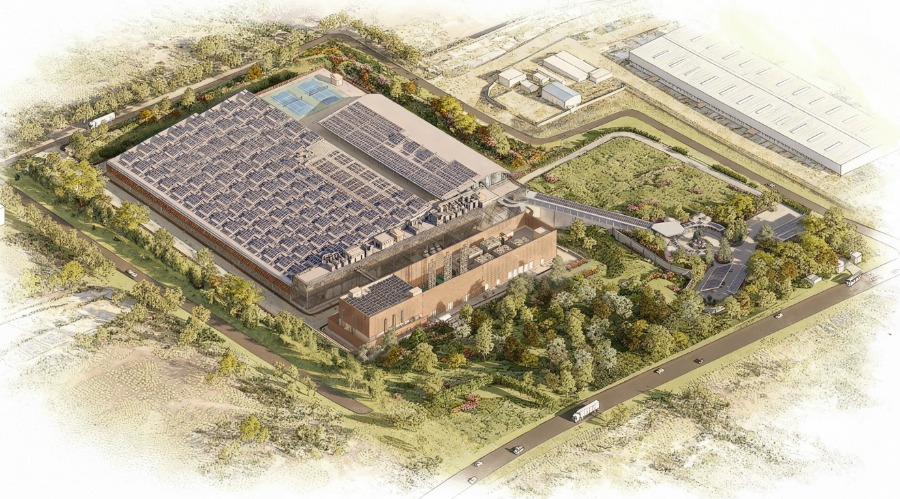
India is set to significantly strengthen its domestic electronics supply chain with the construction of what is being billed as the country’s largest and most sustainable printed circuit board manufacturing facility, as work begins on a new plant in Sehore, Madhya Pradesh.
Designed by Studio Saar for its parent company Secure Meters, the 50,000 square metre factory – known as Secure Sehore – is scheduled for completion in October 2026. Once operational, the facility is expected to meet around 30% of India’s PCB demand, a sharp increase for a sector where only about 10% of components are currently sourced domestically.
The project is being positioned as a strategic investment in India’s high-tech manufacturing resilience, reducing reliance on imports of PCBs, which are essential components across consumer electronics, industrial equipment and energy infrastructure. At peak capacity, the site will employ around 1,000 people, with approximately 500 staff working on site at any one time.
A central feature of the development is its emphasis on water stewardship, a critical issue for PCB manufacturing, which is highly water intensive. Secure Sehore will require up to one million litres of ultrapure water each day. According to the project team, an on-site, state-of-the-art water purification system will recycle 95% of that volume, well above the industry norm of between 65% and 75%.
To further mitigate water risk, the plant will incorporate a network of underground storage tanks with a total capacity of 11 million litres, designed to harvest rainfall throughout the year. These tanks have been constructed using traditional masonry methods, including stone, lime mortar and fly-ash bricks. Earth excavated during construction is being reused to form landscaped mounds above the tanks, which will help protect the site from dust storms common to the region.
The development has already had knock-on economic effects locally. Three new fly-ash brickworks were established to supply the project and have since secured multi-year contracts from other developments in the area. All structural materials for the factory are being sourced from within a 60-kilometre radius of the site.
Energy use has also been a key consideration. The facility will operate entirely on renewable power, with 4MW of its 14MW requirement generated on site via photovoltaic panels. The remaining electricity will be sourced from certified renewable providers, combining solar and wind generation.
Architecturally, the factory has been designed around passive, circular and regenerative principles. A double-skin façade, featuring angled red sandstone panels, is intended to provide passive shading and reduce heat gain. The façade system uses natural stack effect ventilation to draw air between layers, while insulated walls and external stone cladding help delay heat transmission. These measures are expected to cut cooling energy demand by between 12% and 15%.
Natural light will be introduced to the factory floor through shaded north-facing glazing and an internal courtyard, reducing the need for artificial lighting and supporting worker wellbeing. Drought-resilient native climbing plants will be grown across the façade to improve air quality around the site.
The structural system is based on a 12-metre grid and uses green steel designed for disassembly and reuse, alongside low-carbon fly-ash concrete. The building has been planned for off-site manufacture to enable faster and more precise assembly, and for eventual disassembly once it reaches its projected 90-year lifespan. Staff facilities will include a rooftop pavilion with a canteen, exhibition areas and indoor and outdoor recreational spaces.
Alongside environmental targets, Secure Sehore places a strong focus on social infrastructure. The site will include medical facilities, a crèche, mass transport for employees, bicycles for on-site movement and gender-neutral sanitary facilities. These measures are intended to support workforce diversity, particularly women, who account for 55% of Secure’s employees.
Ananya Singhal, Managing Partner at Studio Saar, said: “Every once in a while you get a chance to work on a scheme that can change paradigms and start with economic, social, carbon, and a biodiverse, regenerative approach. By working with Secure from the fundamentals of their process needs to the overall design of the scheme, we have eked out all the benefits and hope to transform how factories are built.”
Suket Singhal, Group CEO and Managing Director of Secure, added: “PCBs are critical to all electronic products, but are essentially a customised commodity. In our business model we are trying to transform the customer service experience; this is only possible to do because the building has been designed from the ground up solely to deliver the new customer service levels.”
The wider site strategy includes a rewilding programme across 40% of the land, with 14,000 trees, shrubs and grasses to be planted using traditional low-water techniques. As India seeks to expand domestic manufacturing capacity, Secure Sehore offers a case study in how industrial growth and sustainability objectives may increasingly converge.

“Friendly zombie fanatic. Analyst. Coffee buff. Professional music specialist. Communicator.”

