
Government review could replace 11 councils with new unitary authorities
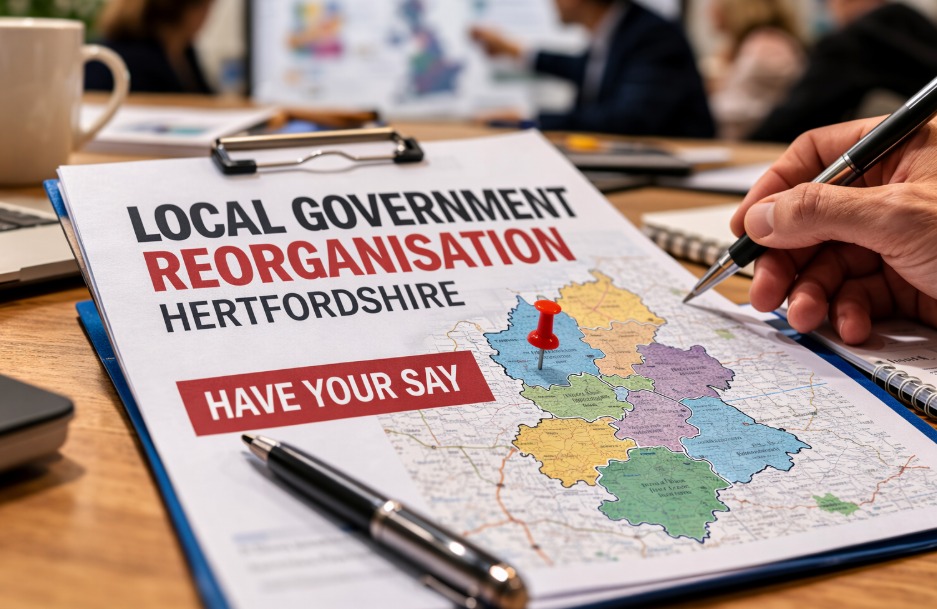
Residents and organisations across Hertfordshire are being reminded to take part in a central government consultation that could significantly reshape the structure of local government in the county.
The consultation, launched in early February, seeks public feedback on proposals to reorganise Hertfordshire’s current council system. Under the government’s plan, the county’s existing 11 councils would be replaced by new unitary authorities responsible for delivering all local government services.
Officials say the consultation represents an important opportunity for communities, businesses and civic groups to influence how local services are managed in the future. The process forms part of a broader national effort to streamline local governance structures and potentially improve efficiency and accountability.
The statutory consultation will remain open until 26 March 2026.
Proposed changes to council structure
Currently, local government services in Hertfordshire are split between Hertfordshire County Council and ten district or borough councils. Under the proposed reorganisation, these responsibilities would be consolidated into a smaller number of unitary councils.
Unitary authorities typically oversee a full range of services, including education, social care, transport, planning and waste management, which are otherwise shared between multiple levels of local government.
Supporters of the model argue that a unified structure can simplify decision-making, reduce duplication of services and improve coordination between departments.
In November 2025, Hertfordshire’s councils jointly submitted proposals outlining three possible structural models for the county’s future governance. The proposals were prepared in collaboration with the county’s Police and Crime Commissioner.
The three options under consideration include the creation of two, three or four unitary councils to replace the current system.
Each proposal sets out potential administrative boundaries, governance frameworks and financial implications for the new authorities.
Consultation process underway
The seven-week consultation invites residents, community groups and businesses to provide their views on the reorganisation proposals before the government reaches a final decision.
Officials say participation from local stakeholders is essential to ensure the proposals reflect the needs and priorities of Hertfordshire communities.
Full details of the proposals, including supporting documentation and financial analysis, have been made publicly available to help residents assess the potential impact of the changes.
These materials include maps outlining proposed council boundaries, detailed business cases for each option and additional background information explaining the rationale behind the proposed reforms.
Members of the public can review the information and submit feedback through the government’s consultation process.
Access to consultation materials
Information about the reorganisation proposals has been made available online through a dedicated website created to support the consultation process.
Residents can access documentation, supporting evidence and links to the government’s consultation through the website at www.hertfordshire-lgr.co.uk.
For those who prefer to review the material in person, printed copies of the consultation documents are also available. Paper versions can be found in council reception areas across the county as well as in Hertfordshire’s public libraries.
Local officials say the range of access options is designed to ensure as many residents as possible can participate in the consultation, regardless of how they prefer to access information.
Decision expected later this year
The consultation is scheduled to close on 26 March 2026, after which the government will review responses before making a final decision on the structure of local government in Hertfordshire.
A decision is expected to be announced in the summer of 2026.
If approved, the reorganisation would mark one of the most significant changes to the county’s governance framework in decades. The transition to unitary authorities would require careful planning to ensure continuity of services during the shift from the current multi-tier system.
For businesses operating in the region, the changes could influence planning processes, economic development initiatives and local regulatory structures overseen by councils.
Public sector observers note that local government reorganisation has been increasingly explored across England as policymakers seek to improve administrative efficiency and strengthen local leadership.
The outcome of Hertfordshire’s consultation will therefore be closely watched by neighbouring regions and local authorities considering similar structural reforms.
Residents and organisations wishing to contribute to the consultation have until 26 March to submit their views before the government begins its assessment of the proposals.

“Friendly zombie fanatic. Analyst. Coffee buff. Professional music specialist. Communicator.”

