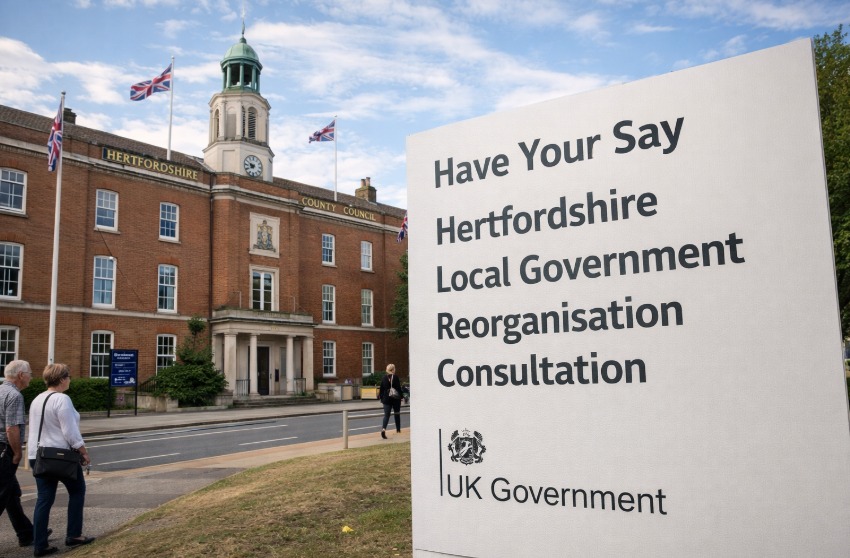
The UK government has opened a seven-week statutory consultation on proposals to reorganise local government in Hertfordshire, inviting residents, businesses and organisations to comment on plans that could significantly reshape how public services are delivered across the county.
The consultation, launched on 5 February 2026, follows a nationwide push by the UK Government to simplify local government structures and reduce administrative costs. In February 2025, councils across England were invited to submit reorganisation proposals, setting the stage for the current review process.
Hertfordshire currently operates under a two-tier system of local government, with district and borough councils delivering a range of local services alongside the county council. District and borough authorities are responsible for functions such as social housing, homelessness support, leisure services, town planning, street cleansing, waste and recycling collections, community and cultural centres, as well as council tax and business rates collection. The county council, meanwhile, oversees services including children’s social care, education and special educational needs provision, libraries, highways, recycling centres, public health and trading standards.
Under the government’s proposals, these existing arrangements would be replaced by new unitary councils. The proposed unitary authorities would take on responsibility for all services currently delivered by both the county council and the district and borough councils, consolidating decision-making and service delivery within fewer organisations.
The consultation marks the latest stage in a process that has involved extensive engagement with residents and stakeholders across the county. Following a series of public events and an online survey, Hertfordshire’s 11 councils, working jointly with the Police and Crime Commissioner, submitted a range of potential options to central government. These include models based on two, three or four unitary councils, each designed to meet government criteria while reflecting local needs and geography.
Full details of the proposals have been published to support the consultation process. These include business cases, financial analysis and maps outlining proposed council boundaries, alongside a direct link to the government’s consultation materials. The information is available online, and paper copies of the consultation will also be made accessible in council receptions and Hertfordshire libraries to ensure residents without digital access can participate.
From a business and public finance perspective, the reorganisation is intended to streamline governance, reduce duplication and deliver long-term savings, while maintaining or improving service quality. Supporters of unitary models often argue that they can provide clearer accountability and more efficient decision-making, though such changes can also involve complex transitions, including the harmonisation of budgets, staffing structures and local policies.
The Leaders of the 11 Hertfordshire councils have jointly encouraged residents to take part in the consultation, emphasising the collaborative approach taken to date.
“We are committed to working together to deliver services that are as simple to access, accountable, and sustainable as possible for our 1.2 million residents.
“We have worked together throughout this process, listening to local communities and developing evidence-based proposals that reflect what matters most to people across our county.
“This statutory consultation is your opportunity to tell Central Government what you think. We encourage you to get involved and make your voice heard.”
The consultation will remain open until 26 March 2026, giving residents and organisations nearly two months to review the proposals and submit their views. Feedback gathered during this period will be considered by central government before a final decision is made.
A government decision on the future structure of local government in Hertfordshire is expected in summer 2026. For businesses, public sector partners and residents alike, the outcome could shape how services are funded, managed and accessed across one of the UK’s largest counties for years to come.

“Friendly zombie fanatic. Analyst. Coffee buff. Professional music specialist. Communicator.”

