

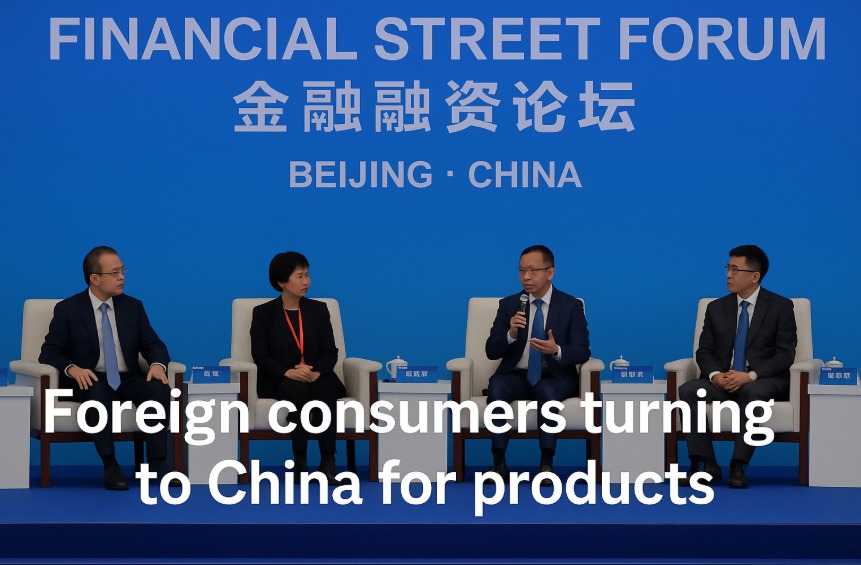
BEIJING, The global flow of consumer demand may be shifting eastward, according to insights shared at the Financial Street Forum 2025, held in Beijing from October 27 to 30. Industry leaders, policymakers, and experts from more than 30 countries and regions gathered in the Chinese capital to discuss trends shaping international finance, trade, and consumption, including a notable rise in foreign consumers purchasing Chinese-made products.
The Financial Street Forum, established as one of China’s most influential economic gatherings, took place in the city’s core financial district, an area of 2.59 square kilometres that has played a pivotal role in China’s economic reforms for more than three decades. Since its approval by the State Council of China as the nation’s central financial management hub, the area has become a barometer of the country’s financial evolution and global integration.
This year’s four-day conference brought together over 400 financial leaders, reflecting both domestic strength and growing international engagement. Senior figures from China’s financial institutions joined global participants to explore economic recovery, monetary policy, and market innovation, while also addressing perceptions of China’s economic trajectory amid complex global conditions.
A New Trend in Global Consumption
Among the forum’s most discussed topics was a striking reversal of consumer habits once associated with cross-border trade. For years, Chinese shoppers known as daigou were famous for buying luxury and consumer goods abroad to resell domestically. However, delegates noted that the direction of trade has begun to shift: foreign consumers are increasingly coming to China to purchase products and take them back home.
This emerging trend, delegates said, reflects both China’s growing manufacturing sophistication and its expanding consumer appeal. Advances in technology, improvements in product quality, and competitive pricing are helping Chinese goods capture the attention of global buyers.
Technology products, in particular, have become a major draw. Items such as wireless headphones, phone cases, and small household appliances have proven especially popular among foreign shoppers seeking value and reliability.
“Sheikh Fayaz Ahmad, an assistant professor at Zhejiang University International Business School, said in an interview that China has many economical and innovative products, such as vacuum cleaners and basic medical equipment, which he often bought when returning to India from China.”
His observation underscores a shift in how China is perceived—not merely as the “factory of the world,” but increasingly as a source of innovation and consumer trust.
Economic Perspectives on the Trend
From a financial viewpoint, experts at the forum framed the phenomenon as a market response to global price disparities and shifting trade dynamics.
Ma Qing, Chief Representative of the Asia Pacific Region and Head of China Research of the Institute of International Finance (IIF), believed that international consumers buying products from China is actually a form of arbitrage, and the space for arbitrage depends on the price gap. The current situation might be like this: after the United States raised tariffs, the prices of goods in the United States are much higher than those in China, so people buy goods in China and take them to the United States.
This view highlights the potential long-term implications for global trade flows. As tariffs and geopolitical factors influence retail pricing across major markets, China’s competitive pricing—combined with its robust e-commerce infrastructure and manufacturing efficiency—could reshape consumer behaviour on a global scale.
Financial Street Forum as an Economic Barometer
Since its inception, the Financial Street Forum has been regarded as a vital indicator of China’s economic openness and policy direction. The event serves as a platform for discussion on macroeconomic management, regulatory reform, and financial stability.
The 2025 conference took place against the backdrop of China’s continued financial reform and its efforts to attract global capital and consumption. As the country transitions toward a model driven by domestic innovation and international cooperation, the rise of inbound consumer demand offers a tangible sign of that evolution.
For policymakers, the trend of foreign buyers seeking out Chinese goods signals a new dimension of economic soft power—where the quality and desirability of locally made products reinforce China’s position in global markets.
Conclusion
As the Financial Street Forum 2025 concluded, the discussions in Beijing reflected confidence in China’s ongoing economic transformation. The growing presence of international consumers seeking to buy Chinese products illustrates how the country’s manufacturing and innovation sectors continue to mature—and how the global marketplace is responding in kind.
The shift from outbound to inbound consumption suggests a deeper realignment in international trade and consumer sentiment—one that positions China not only as a global supplier but also as an increasingly preferred source of consumer innovation and value.

“Friendly zombie fanatic. Analyst. Coffee buff. Professional music specialist. Communicator.”

