


Glasgow research challenges assumptions of a unified electorate
A new data visualisation project from University of Glasgow is challenging conventional assumptions about Scotland’s political identity, revealing a far more complex and locally varied electoral landscape than national results suggest.
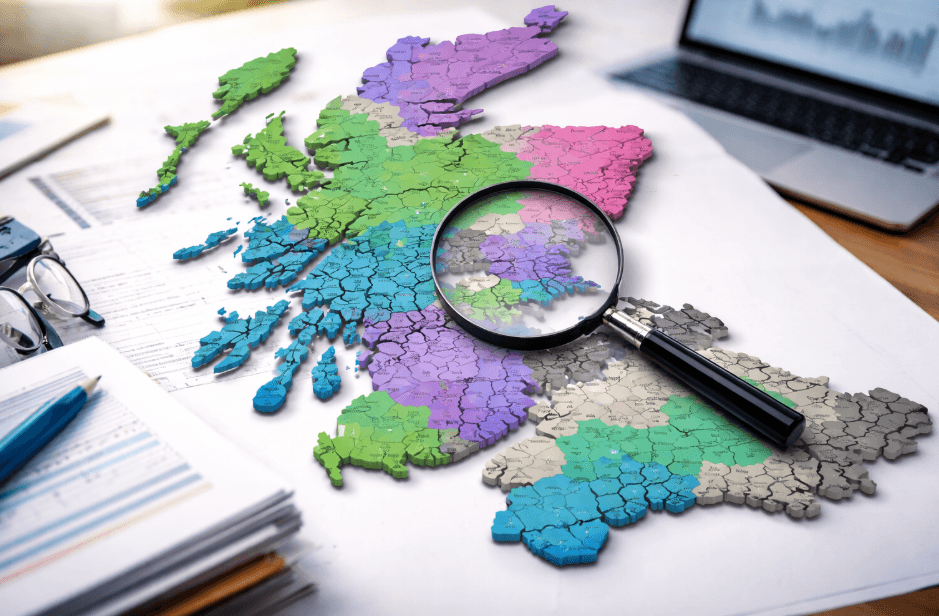
Researchers analysing voting patterns from the 2014 Scottish independence referendum and the 2016 Brexit vote have developed a cartogram that reshapes the country according to population size while simultaneously illustrating political preferences. The findings, published in the academic journal Regional Studies, Regional Science, highlight significant regional and sub-regional differences that are often obscured in broader political narratives.
Cartogram highlights regional contrasts across Scotland
The project uses UK Electoral Commission data to map voting behaviour across five regions defined by the European Union’s Nomenclature of Territorial Units for Statistics. These include Highlands and Islands, West Central Scotland, North Eastern Scotland, Eastern Scotland and Southern Scotland. Each area is colour-coded to reflect combined support for Scottish independence in 2014 and Brexit in 2016.
The resulting visualisation paints a fragmented picture. Scotland’s largest urban areas, particularly Glasgow and surrounding constituencies, show stronger support for independence alongside more varied attitudes towards EU membership. By contrast, Edinburgh and much of the east coast appear more aligned with maintaining the Union and remaining within the EU.
Southern Scotland presents a particularly mixed political profile. Areas closer to the English border tend to favour remaining in the UK while supporting Brexit, whereas regions nearer the central belt display stronger backing for independence and EU membership. In North Eastern Scotland, Moray stands out for its relatively average stance on independence but significantly higher support for leaving the EU.
The Highlands and Islands, compressed in the cartogram due to lower population density, also reveal contrasting preferences. Orkney and Shetland lean more towards opposing independence while supporting Brexit, while mainland areas demonstrate different combinations of political alignment.
Researchers stress importance of localised political analysis
Craig Stewart, the study’s lead author, said the visualisation challenges widely held assumptions about a uniform Scottish political identity. He said: “In 2014, people in Scotland voted 55.3% in favour of and 44.7% against the question of whether Scotland should be an independent country. In 2016, 38% of the votes cast were in favour of the UK leaving in the European Union. In the many debates and discussions about those results since, politicians, commentators and members of the public have often treated those results as evidence of the preferences of the Scottish electorate as a whole. Urban areas are often thought to favour impendence and remaining in the EU, with rural areas taking the opposite view on both.
“What this cartogram reveals clearly is that the results of both referendums have significant local variations, which have often been masked by those broader national and regional analyses. We can’t simply treat Scotland or any region within it as a unified whole when the picture is much more nuanced than that.”
Co-author Xinyi Yuan emphasised the importance of granular analysis in understanding voter behaviour. She said: “Understanding voter behaviour fully requires analysis at across neighbourhood, city, and regional levels to properly capture social and cultural context. This cartogram helps bring that to life in a striking visual. We hope it will help encourage more awareness of Scottish voters’ diversity of opinion and inspire more nuanced discussion of Scottish politics in the future.”
Growing role of geospatial tools in policy and business insight
The research also underscores the increasing importance of geospatial data and visualisation tools in both political and business analysis. By presenting complex datasets in an accessible and intuitive format, cartograms and similar techniques are being adopted across sectors, including urban planning, economic forecasting and market intelligence.
Dr Mingshu Wang, corresponding author of the study, highlighted the broader academic and practical significance of the work. He said: “The University has a long history of teaching and research excellence in cartography. Over time, that has evolved into geoinformation technology, where we produce maps which can make a variety of data much more understandable and accessible.
“This cartogram was produced during an ongoing assessment as part of the in visualisation and map use course. It’s a testament to the quality of the work that it has been published in a peer-reviewed journal. It’s a great example of how maps can act as a bridge between disciplines by enabling a new perspective on politics in Scotland.”
Implications for policymakers and future research
The study, titled ‘Scotland’s twin referendums: revealing regional divides behind national votes’, adds to a growing body of research suggesting that political and economic policymaking must account for localised differences rather than relying solely on aggregate national trends.
For business leaders and policymakers alike, the findings reinforce the need for more targeted, region-specific strategies when assessing public sentiment, economic priorities and long-term investment decisions across Scotland.

“Friendly zombie fanatic. Analyst. Coffee buff. Professional music specialist. Communicator.”