

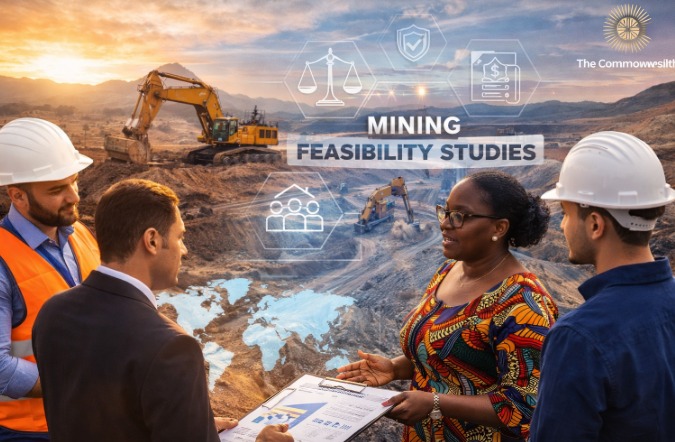
The Commonwealth Secretariat has unveiled new guidance designed to help governments take more informed decisions on mining projects, as countries face rising demand for critical minerals and increasing scrutiny over the environmental and social costs of extraction.
Launched in London on Wednesday, 21 January, the Commonwealth Model Mining Feasibility Study Guidelines were introduced during the Secretariat’s inaugural Environmental Resilience Day, positioning feasibility studies as a key public interest tool in shaping development outcomes.
The Secretariat said the guidelines aim to strengthen how governments assess mining proposals, placing feasibility studies at the centre of regulatory decision-making rather than treating them as a purely technical or commercial exercise.
Commonwealth Secretary-General Hon Shirley Botchwey said mineral resources remain a vital source of revenue for many member countries, while also offering a route towards more resilient and inclusive growth.
“At its heart, the Model Mining Feasibility Study Guidelines are about a simple but vital question: is this project truly in the national interest? A feasibility study should be more than numbers on a page. It should ask whether developing a resource will create lasting value, protect people and the environment, and strengthen long-term economic security. When this work is done poorly, countries can be locked into harmful outcomes for generations. When it is done well, it can become a powerful driver of sustainable growth.”
The guidelines are intended to provide a clearer framework for governments to review feasibility studies submitted by mining companies, which often form the basis for approvals, licensing and investment decisions.
The Secretariat said feasibility studies should be seen as the first major test of whether a proposed project should proceed, rather than simply a step to confirm financial viability. By improving the quality and consistency of assessments, the guidelines are expected to support more transparent decision-making across the mining project lifecycle.
The guidance has been developed under the Secretariat’s Energy and Natural Resources workstream, led by Naadira Ogeer, Head of Energy and Natural Resources at the Commonwealth Secretariat, who spearheaded the initiative.
“These Guidelines were developed at the request of our member countries to support more informed and transparent decision-making across the mining project lifecycle. They respond to the current absence of model guidelines and will assist governments as they review and engage with mining feasibility studies going forward. This is especially important given the growing global demand for critical minerals and long investment cycles.”
Mining feasibility studies typically assess the technical and financial viability of a project, covering factors such as extraction methods, processing requirements, infrastructure needs and projected costs and revenues. However, the Commonwealth Secretariat stressed that a feasibility study is not simply a technical or financial process or document, but a central decision-making tool for governments.
It said the new guidelines will assist public authorities in building the tests needed to determine whether a proposed mining project is realistic, responsible and aligned with national development priorities.
The Secretariat warned that without rigorous feasibility studies, governments risk approving projects that may not be sustainable or may fail to deliver the expected economic benefits. It also said poorly assessed projects can create disproportionate social and environmental costs, leaving communities and states exposed to long-term liabilities.
The launch comes as critical minerals such as lithium, cobalt, copper and rare earth elements have become increasingly strategic for global supply chains, driven by investment in electric vehicles, renewable energy and wider electrification. Many Commonwealth countries are resource-rich, placing them at the centre of a growing competition for investment while also facing heightened expectations on governance, transparency and environmental protection.
The Secretariat’s Environmental Resilience Day, where the guidelines were launched, highlighted work led by its Climate Change and Oceans Directorate, which includes the Energy and Natural Resources section. The Directorate has been positioned as a core pillar of the Commonwealth’s Strategic Plan 2025–2030.
Held under the theme “A Resilient Commonwealth: Driving environmental resilience for people and planet,” the event brought together UK-based High Commissioners, private sector representatives, academics and youth organisations.
The Secretariat said discussions focused on strengthening collaboration across resilience planning, improving access to finance, accelerating the energy transition and shaping global climate, ocean and natural resource governance.
In addition to the feasibility guidelines, the Secretariat also released a separate publication, Understanding Mining Feasibility Studies | Commonwealth, aimed at improving awareness of what feasibility studies are and how they should be used in public decision-making.
The Commonwealth Secretariat said the new model guidelines respond to the absence of standardised approaches for governments assessing mining feasibility studies, particularly in smaller or capacity-constrained administrations. By setting clearer expectations and supporting stronger review processes, the Secretariat hopes member states will be better equipped to negotiate with mining companies, safeguard public interests and ensure extractive projects contribute to long-term development goals.
The guidance is expected to be relevant across a wide range of mining jurisdictions, including those seeking to attract new investment, expand existing production, or manage the transition towards more sustainable and responsible resource development.

“Friendly zombie fanatic. Analyst. Coffee buff. Professional music specialist. Communicator.”

